
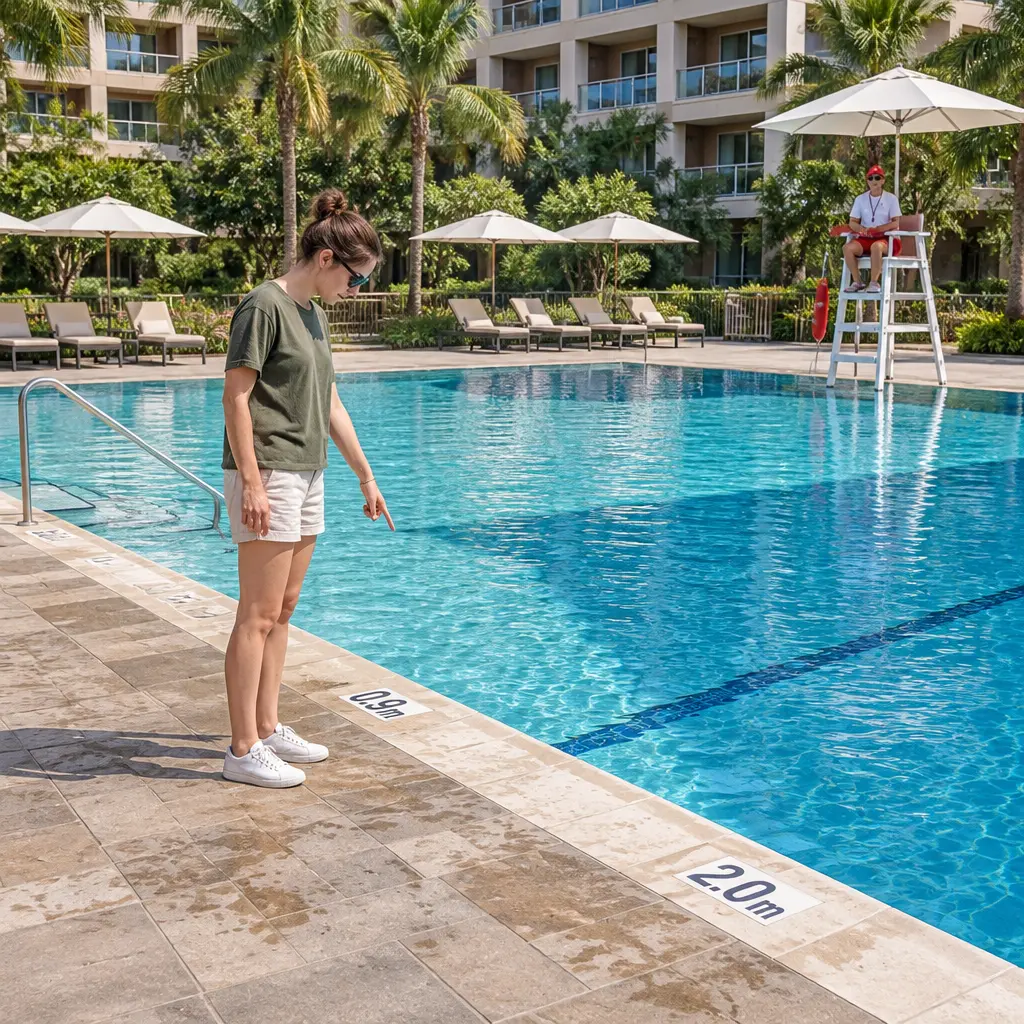
Pool depth gradients and lifeguard presence are two central safety checks to make before booking a hotel, club, vacation rental, or other facility with a swimming pool. A depth gradient is the change in water depth across the pool, shown by measurements and signs; lifeguard presence means a trained attendant is actively supervising swimmers during the hours you plan to swim. Check both directly with the facility, then verify supervision hours, shallow-water markings, and rules for children and non-swimmers. The CDC reports that drowning is a leading cause of unintentional injury death for children, and that barriers, close supervision, and swimming skills all contribute to prevention. These checks help you compare facilities without treating a lifeguard as a substitute for personal supervision or clear pool information.
Pool depth gradients explain how water depth changes
A pool depth gradient is the pattern of increasing or decreasing water depth from one area to another. The term can describe a gradual slope, a sharply defined transition, or separate shallow and deep zones. The CDC’s Model Aquatic Health Code (MAHC) provides guidance for aquatic venues on design, operation, and safety; local laws and adopted codes determine what a specific facility must follow. For a guest, the practical question is whether the pool’s layout and depth are easy to understand before entering.
Depth information is especially important for children, inexperienced swimmers, and anyone who may assume that a pool floor remains level. The American Red Cross advises swimmers to know the water depth and their own ability, and to enter feet first when they do not know the depth. A visible depth marker is useful only if it is accurate, legible, and positioned where swimmers can see it.
Gradual slopes and shallow-to-deep transitions
A gradual slope is a pool floor that becomes deeper over distance; a transition is the point where a shallow area gives way to deeper water. These features may be found in family pools, leisure pools, and pools with beach-style entries. Ask the facility where the shallow area ends, where the floor begins to slope, and whether the transition is marked both on the deck and in the water.
Do not infer depth from appearance, pool size, or the location of a ladder. Request the actual depth range and confirm that signs or markers identify relevant changes. If the facility cannot explain the layout clearly, treat that uncertainty as a reason to choose another pool or restrict swimming to a clearly identified area.
Depth markers, warning signs, and diving areas
Depth markers state the water depth at designated points; warning signs communicate hazards or restrictions, such as no diving. Their placement and requirements vary by jurisdiction and pool type, so a visitor should not assume that every pool uses the same standards. Look for markers on the pool deck and, where provided, on the pool wall. Confirm which areas permit diving rather than relying on water depth alone.
The CDC and the U.S. Consumer Product Safety Commission emphasize preventing head and neck injuries by avoiding dives into shallow or unfamiliar water. If a pool’s diving rules or depth information are missing, unclear, or inconsistent, do not dive. Ask staff to clarify the rules before anyone enters the water.
Pool types and their distinct depth risks
Common pool categories include wading pools, shallow leisure areas, lap pools, deep-water pools, and pools with diving boards. Each creates different supervision and depth questions: a wading pool may be shallow but still requires close child supervision, while a lap pool may have lanes and deeper sections that are unsuitable for weak swimmers. A spa or hot tub is not a substitute for a swimming area and has separate health and safety considerations.
For every type, ask which areas are open during your booking, whether depth changes are marked, and whether any section is closed or restricted. A pool’s label—such as “family pool”—does not establish that every depth or feature is suitable for every swimmer.
Lifeguard presence determines what supervision is available
Lifeguard presence means that a trained, designated person is on duty to observe swimmers and respond to emergencies. It is different from a staff member who is nearby but has no assigned water-supervision role. The American Red Cross recommends swimming in areas supervised by lifeguards when possible, while also stressing that caregivers must actively watch children. A lifeguard reduces risk but cannot guarantee that an incident will be prevented.
For booking decisions, verify the schedule rather than relying on a listing that simply says “lifeguard on duty.” Supervision may differ by day, season, pool area, or time of day. Ask whether the guard will be present during your entire planned swim and whether the service applies to the specific pool you intend to use.
On-duty lifeguards versus unstaffed pools
An on-duty lifeguard is assigned to monitor swimmers and is positioned to respond; an unstaffed pool has no dedicated lifeguard. Facilities may use signs, access controls, or emergency equipment at unstaffed pools, but these measures are not equivalent to active professional supervision. Ask the facility to state plainly whether a lifeguard will be present at the time of your visit.
If no lifeguard is provided, decide whether the pool remains appropriate for your group. Keep a capable adult within immediate reach of young children, maintain continuous attention, and avoid distractions such as phones. The CDC’s drowning-prevention guidance identifies close, constant supervision as a key protection for children, particularly around water.
Coverage hours, pool zones, and staffing limits
Coverage hours are the specific times when a lifeguard is on duty; coverage zones are the pool areas included in that supervision. A guard may cover only a main pool, while a separate children’s pool, spa, or adjoining water feature is unsupervised. Ask whether coverage includes the full facility, whether there are breaks or scheduled closures, and what happens when the guard leaves the station.
Do not assume that a lifeguard’s presence means every swimmer is individually monitored. Pool size, crowding, visibility, and the number of active areas can affect how well staff can observe the water. If conditions appear crowded or supervision seems unclear, choose a quieter time or another facility.
Lifeguard qualifications and emergency readiness
A qualified lifeguard has current training appropriate to the facility and role, which may include water rescue, CPR, first aid, and use of an automated external defibrillator. Certification standards and legal requirements vary, so ask what training the facility requires and whether emergency equipment is available. The American Red Cross offers lifeguard training and certification programs, but a guest should confirm the facility’s own staffing arrangements rather than infer credentials from a uniform or chair.
Also ask how staff summon emergency services and where rescue equipment is located. These details do not replace prevention, but they help assess whether the facility has a clear response plan.
Booking checks combine depth information and supervision
Depth gradients and lifeguard presence should be assessed together: clear depth information helps swimmers choose a suitable area, while supervision supports observation and response. Neither makes a pool risk-free. The CDC’s 2024 drowning-prevention materials report that more than 4,500 people died from drowning each year in the United States during 2020–2022, underscoring why visitors should verify safety arrangements rather than rely on assumptions.
Questions to ask before confirming a booking
Contact the facility directly and request specific answers. A booking page may omit seasonal schedules or details about pool areas, so written confirmation is useful when safety arrangements affect your decision.
- What are the shallowest and deepest points, and where does the floor slope?
- Are depth changes and no-diving areas clearly marked?
- Will a lifeguard be on duty during our planned swim, and which pool areas are covered?
- Are there scheduled breaks, seasonal changes, or periods when the pool is unstaffed?
- What age, swimming ability, or adult-supervision rules apply to children?
- Are rescue equipment, a first-aid kit, and an emergency response procedure available?
A practical pre-swim inspection
When you arrive, compare the actual pool with the information provided during booking. Check that markers are visible, the pool layout matches the description, and the lifeguard is present if one was promised. Reassess if the pool is unusually crowded, a section is closed, visibility is poor, or the water conditions make it difficult to see swimmers.
- Locate the posted depth information and identify shallow, sloped, and deep areas.
- Confirm which zones are supervised and whether the lifeguard is currently on duty.
- Set a clear supervision plan for children and non-swimmers, including an adult watcher who is not distracted.
- Keep non-swimmers in water they can manage and use properly fitted flotation equipment where appropriate; do not treat flotation aids as a replacement for supervision.
- Leave the pool or contact staff if safety information is missing or conditions differ materially from what was promised.
How to compare facilities consistently
Use the same criteria for each venue: depth transparency, visible markings, confirmed lifeguard hours, supervision coverage, child policies, and emergency readiness. A simple comparison table can record each facility’s answers and flag unanswered questions. This makes the decision more reliable than choosing on amenities or price alone, especially when traveling with children or swimmers of different abilities.
For illustration, a hotel that confirms a marked shallow section and lifeguard coverage during the family’s swim window may be a better fit than a property with a larger pool but uncertain staffing. This is a decision example, not a claim about a particular hotel; visitors should verify details with the actual operator.
Conclusion: verify the pool before you book
Pool depth gradients show where water becomes deeper, while lifeguard presence indicates whether trained supervision is available at the time and place you plan to swim. Before booking, confirm depth ranges, slope transitions, signs, lifeguard hours, coverage zones, and rules for children and non-swimmers. On arrival, check that conditions match what the facility described and maintain active supervision regardless of staffing. Contact the venue with the checklist above, and consult CDC, Red Cross, and local public-health guidance for further water-safety information.
Sources: Centers for Disease Control and Prevention, Drowning Prevention, https://www.cdc.gov/drowning/prevention/; Centers for Disease Control and Prevention, Model Aquatic Health Code, https://www.cdc.gov/model-aquatic-health-code/; American Red Cross, Water Safety, https://www.redcross.org/get-help/how-to-prepare-for-emergencies/types-of-emergencies/water-safety.html; American Red Cross, Lifeguarding, https://www.redcross.org/take-a-class/lifeguarding; U.S. Consumer Product Safety Commission, Pool Safely, https://www.poolsafely.gov/